Sunday, July 11, 2010

Copan Ruinas

On the western side of Honduras, a few hours from the Guatemala border, lies Copan that traces its foundations to the Mayas. Now a hot spot for tourists, Copan boasts some of the best preserved Mayan ruins in Central America.

The immense plaza of lush green is dotted with different mounds, alters and stelas.


This is part of the ball court.

This is the second largest ball court, the first being in Chichen Itza, Mexico, in Central America. The goal was for the players to get an 8 pound ball to hit the protruding stone, toward the right of the photo.
The lucky winners were sacrificed. Sometimes it is good to be a loser.

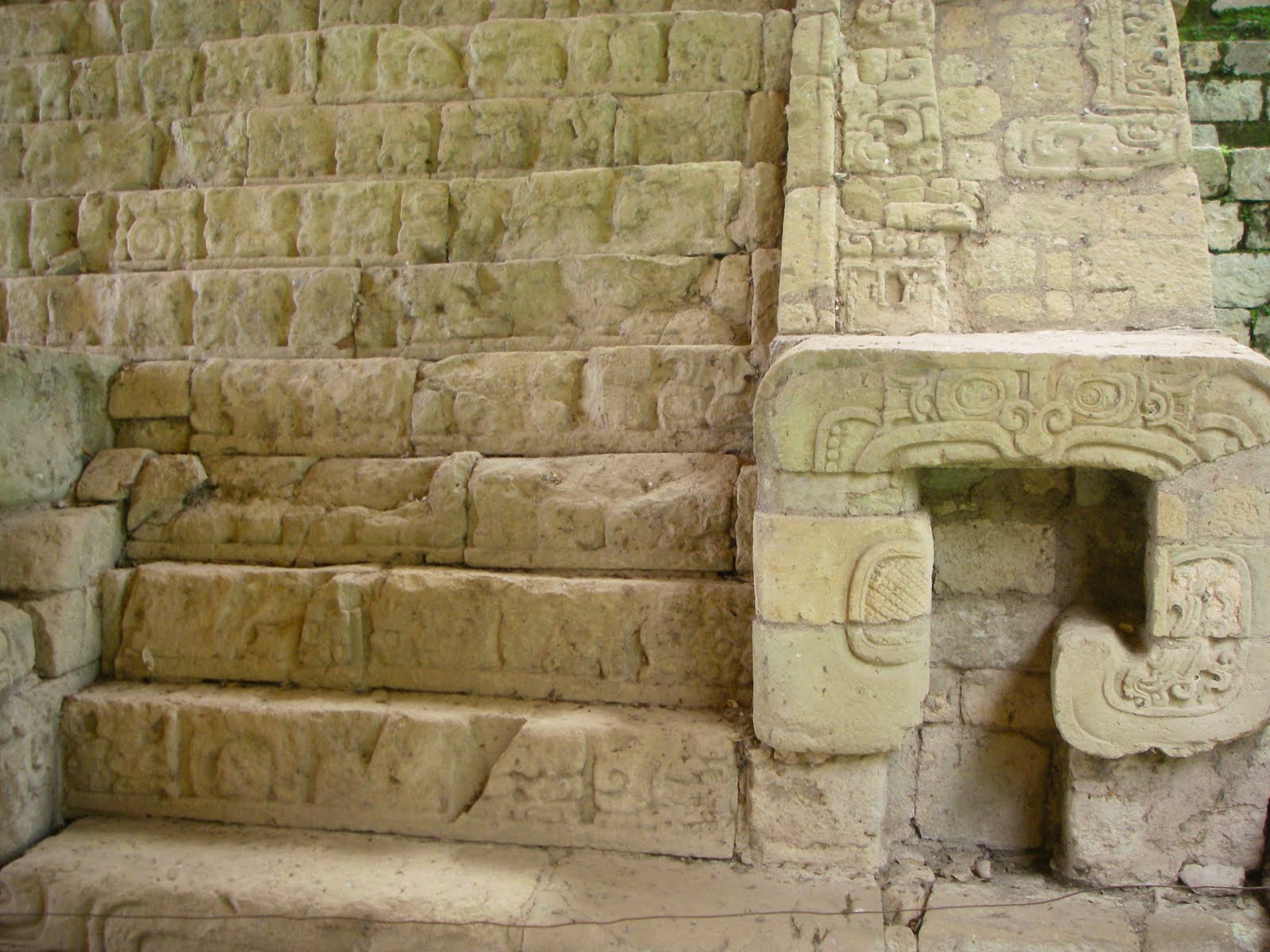
The 63 steps and two thousand glyphs tell the history of the royal house of Copan. The stairway is the longest known text of ancient Mayan civilization.

The Jaguar Court is the site of the ball court sacrifices.

Beautiful macaws enliven the ruins.

Thursday, July 8, 2010

Are we a People of Peace?

This month will mark the 90th anniversary of the founding of Mennonite Central Committee (MCC) that was formed when several Mennonite conferences met in Elkhart, Indiana. MCC began by delivering aid in Russia, Ukraine and Turkey. Since then, thousands have served with MCC in more than 50 countries, working alongside local churches and communities to carry out disaster relief, sustainable community development and justice and peace-building work in the name of Christ. MCC workers attempt to build bridges to connect people and ideas across cultural, political and economic divides. From the beginning, MCC has been grounded in the Mennonite Church that at its core, values peacemaking.

Peacemaking is when Colombian communities, divided and devastated by civil war, are able to tell their stories through a peace quilt. Peacemaking is when the Honduran Mennonite Church works together to understand what it means to be a peace church so that as one body, it can be a witness in a politically divided country. Peacemaking is advocating for communities impacted by the mining companies in Guatemala. Peace is political, BUT….

Have we forgotten that peacemaking is building relationships with our neighbors? Peacemaking is sharing a meal with those of different faiths and cultures. Peacemaking is helping to create viable economic markets for small farmers. Peacemaking is supporting education opportunities for children without access. Peacemaking is encouraging reforestation efforts.

MCC is an organization that seeks peace through the work of churches and partners around the world. All of the work is fundamentally based in peacemaking. Please join MCC’s efforts to be a people of peace both locally and globally.

Wednesday, July 7, 2010

Worlds Apart

It is easy to identify the differences and to do it quickly. When I arrived in Mexico I had the pleasure of testing all kinds of new foods, very different from the Tex-Mex food that passes for Mexican cuisine in States. Now I eat picante on freshly made tortillas or quesadillas filled with nopales or rajas for lunch served between 2:00 and 3:00 in the afternoon, and I can buy a variety of fried foods from any number of vendors that crowd the streets. I am resigned to the idea that waking up early to finish errands before work is impossible since businesses do not open until at least 9am and more often 10am. I rely on the corner store for quick access to milk or cheese and on the markets that spring up around the city selling fresh fruits and vegetables. I take for granted the extensive and secure bus system that reaches all the vast parts of Mexico. The education experience for the children I know in places like the state of Guerrero includes rote learning and months where classes are held less than 50 percent of the days. And this passes as normal. While I am one border crossing away from my home, I feel worlds apart.

After more than a week in Honduras, comparisons abound. Again it is easy to identify the glaring differences between two countries that while sharing a language, seem worlds apart. The hot and humid days begin before 8am with a heavy breakfast of eggs, refried beans, cheese and tortillas. I do not have to wait until mid afternoon to lunch on baleadas (large flour tortillas filled with beans, eggs and dry crumbly cheese) or tejadas (fried plantains). In talking with the Mennonite Central Committee (MCC) workers, I quickly realize that it is not safe to be out at night alone in cities like San Pedro Sula, especially as a woman. Most have been mugged at some point during their time, losing only material wealth like money, cell phones or cameras. There is a heightened sense of insecurity. The bus system feels chaotic with people shouting destinations, luring us to repainted school buses for long, hot bus rides across a country a quarter of the size of Mexico.

And yet, underneath these obvious differences, are we worlds apart? What is it that tips the balance in society? What does it take to create a breakdown in trust in communities or lack of faith in the legal and judicial system? Thus far shielded from the violence of the narcotraficantes (drug traffickers), will this violence permeate Mexican society and filter through communities in the US? How can we respond in our communities, worlds apart, yet connected and dependant on one another?

Saturday, July 3, 2010

Regional Retreat

It was a short night of sleep after Friday evening’s talent show that included our lucha libre skit, a tongue and cheek commentary on Mennonite Central Committee (MCC). I said goodbye to my beloved equipo fuerte (strong team) this morning at 3am. Equipo fuerte, as we Mexico workers named ourselves for the week, stems from our airport experience on Monday. The airline offered food and lodging for the night plus an additional $200 USD to two people willing to change flights. It was definitely enticing, but I told Alejandro, the TACA representative, that it was all seven of us or none at all because we were un equipo bien fuerte (a very strong team), which produced plenty of laughter. The team did not let me forget my statement that made an appearance in our skit.

While the week’s morning workshop sessions were less than inspiring, I was impressed with the quality and dedication of workers that MCC has working in the region. In a region that is plagued by insecurity and a widening economic gap, there is much reason for hope through the MCC work with partners and communities. MCC supports food security projects in western Guatemala that includes advocacy surrounding the impact of Canadian mining in the region. MCC supports the Honduran Mennonite Churches in their quest to be a witness for peace in a country reeling from political instability after Zelaya, the country’s president, was forcibly removed from power a year ago. MCC supports youth and children in Nicaragua through education projects.

Despite geographical proximity, we all live in a different reality shaped by our context; however, we are drawn together by our desire for mutual transformation, a process of sharing and learning together. The work of MCC will not change the course history, but I do have hope that the work of MCC will plant seeds of hope in individuals and communities that has the potential for change.

Monday, June 28, 2010

Heading to Honduras

The MCC Mexico team had a wonderful weekend together; relaxing in Mexico City, reflecting on our experiences these last few months, suffering Mexico’s loss in the World Cup and celebrating the work and contributions of Natalie, our SALT participant who has been in Cuernavaca this past year. I am so grateful to be a part of this supportive group. We listen to each other, laugh together and join in the struggle and work of hope and peace.

Today we leave the confetti strewn office for Honduras to spend a week at the MesoAmerica Retreat with other Mennonite Central Committee (MCC) workers from Central America. The Parque Nacional Cerro Azul Meambar (PANCAM) and the MCC Honduras team will play host to over 40 people working in Guatemala, El Salvador, Honduras and Nicaragua. I am excited to meet others working in the region with MCC and to experience my first foray in Central America.

Saturday, June 26, 2010

Pride

I should have realized something out of the ordinary was going on at the Zócalo when at the exit of the metro I saw several bare chest men sparkling with glitter. There was a more than usual push of people at the metro exits due to several exits blocked off to accommodate the FIFA Fan Fun Center that covered the entirety of the Zócalo.

We went to the Zócalo on the eve of the Mexico vs. Argentina game to avoid tomorrow’s crowd but still be part of the FIFA fever. Unfortunately we were denied entrance to the FIFA Fan Fun Center. The stage was empty and the big screen was quiet. Nobody was attending the tents of food, games and souvenirs. Not to be deterred, we walked to another entrance in hopes of charming the guard to let us walk the grounds that would be saturated with fans tomorrow.

We were again denied as closing time was 6pm. However, the visit was not in vain. The rainbow flags were waving and people of all shapes, sizes and orientation were parading the closed streets and sidewalks. The clothing and makeup brought a lively lift to the Zócalo with the FIFA setup as a backdrop. Rounding the last corner of the Zócalo, we stumbled over the usual protesters camping out in the Zócalo, not to be denied attention for their cause.

Never a dull moment in the City’s center.

Saturday, June 19, 2010

The Music of Puebla

Last night we sat outside at one of the many eateries surrounding Puebla’s zocalo (main plaza). Three doors down a singer crooned out of tune, accompanied by a guitarist. The wait staff at our restaurant sang along to the seemly well known songs, oblivious to the discord. To serenade the patrons of our restaurant, two roaming musicians briefly competed with the amped, off key singer. Welcome to Puebla.

Puebla is home to the famous 5 de mayo battle of 1862 where confounding all expectations, Mexico defeated the French troops. Often thought of by my students, and probably many in the US, as Mexico’s Independence Day, 5 de mayo simply marks the victory of a battle, which, often forgotten, ended in the French winning the war. 5 de mayo is the name of Puebla’s main walking street that is lined with retail stores, and changes into 16 de septiembre, Mexico’s actual Independence Day, on the south side of Reforma.

5 de mayo, Puebla´s walking street

If I was not distracted by the musicians at the cafes and restaurants, I was soaking in the beauty of the colonial buildings, studded with Puebla’s famous azulejos (ceramic tiles), and numerous churches and cathedrals. The main cathedral, which boosts the highest tower in Mexico, is on the 500 peso bill if you do not make it to Puebla to see for yourself. This afternoon, with the cathedral as their back drop, the teenage praise band sang their Alleluias and Amens to a swaying crowd, arms lifted to God.


the Cathedral

Stuffed from one of Puebla’s culinary specialties, mole poblano, I sat in the city’s theater, located off the zocalo that was hosting a weekend of music, free to the public. The rock fusion group that took the stage was composed of a group of young Puebla musicians who used strings, like the cello, viola and violin in conjunction with the accordion or saxophone to create some rock music. I really appreciated their style and their approach until they got a little too experimental for my taste.

enchiladas con mole poblano
mole poblano is a rich chocolaty sauce

the classic restaurant ambience

chile en nogada
another Puebla specialty, it is a chile poblano with a meat filling, doused in a sweet, creamy sauce

Before we returned to the bus station for our two hour ride to Mexico City, it was one more moment of music at the churrería. We opted for the table not immediately in front of the singer and his guitar. He sang and strummed, with more interest in his cigarette break than his music.